
A closed-loop approach that connects planning, projects, assets, operations, and financials so data drives better outcomes at every step.
One Continuum · Complete Context · Real Insight
Planning.
Projects.
Assets.
Operations.
Intelligence.
The real issue isn’t software. It’s fragmentation — systems, data, and processes that don’t connect to how the organization actually operates.
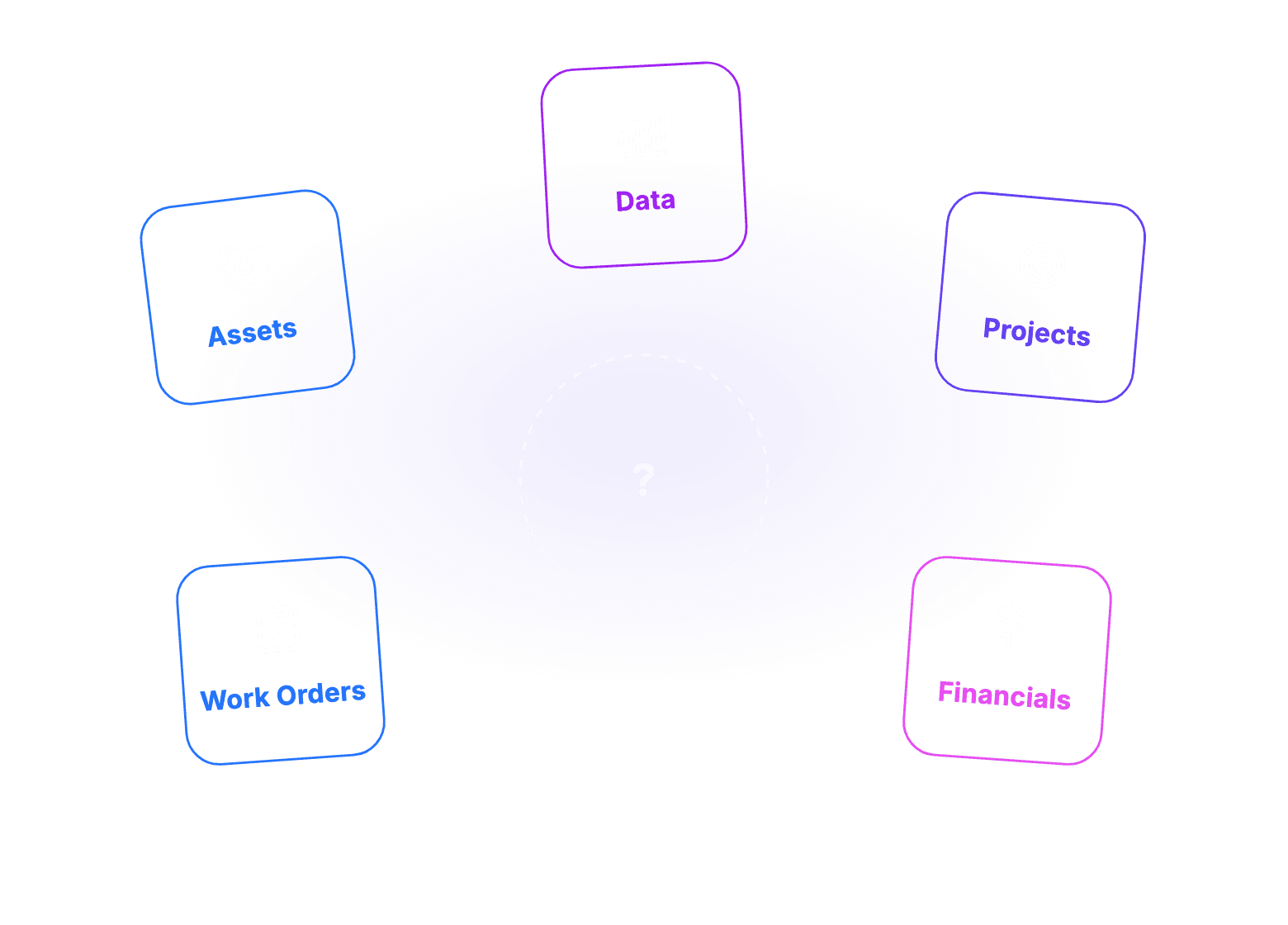
Reactive decision-making
Decisions made without connected data create risk and rework.
Siloed systems and data
Each system tells a partial story. No one sees the full picture.
Misaligned priorities
Capital and operational priorities don't talk to each other.
Higher risk and cost
Fragmentation means more surprises — and more expensive ones.
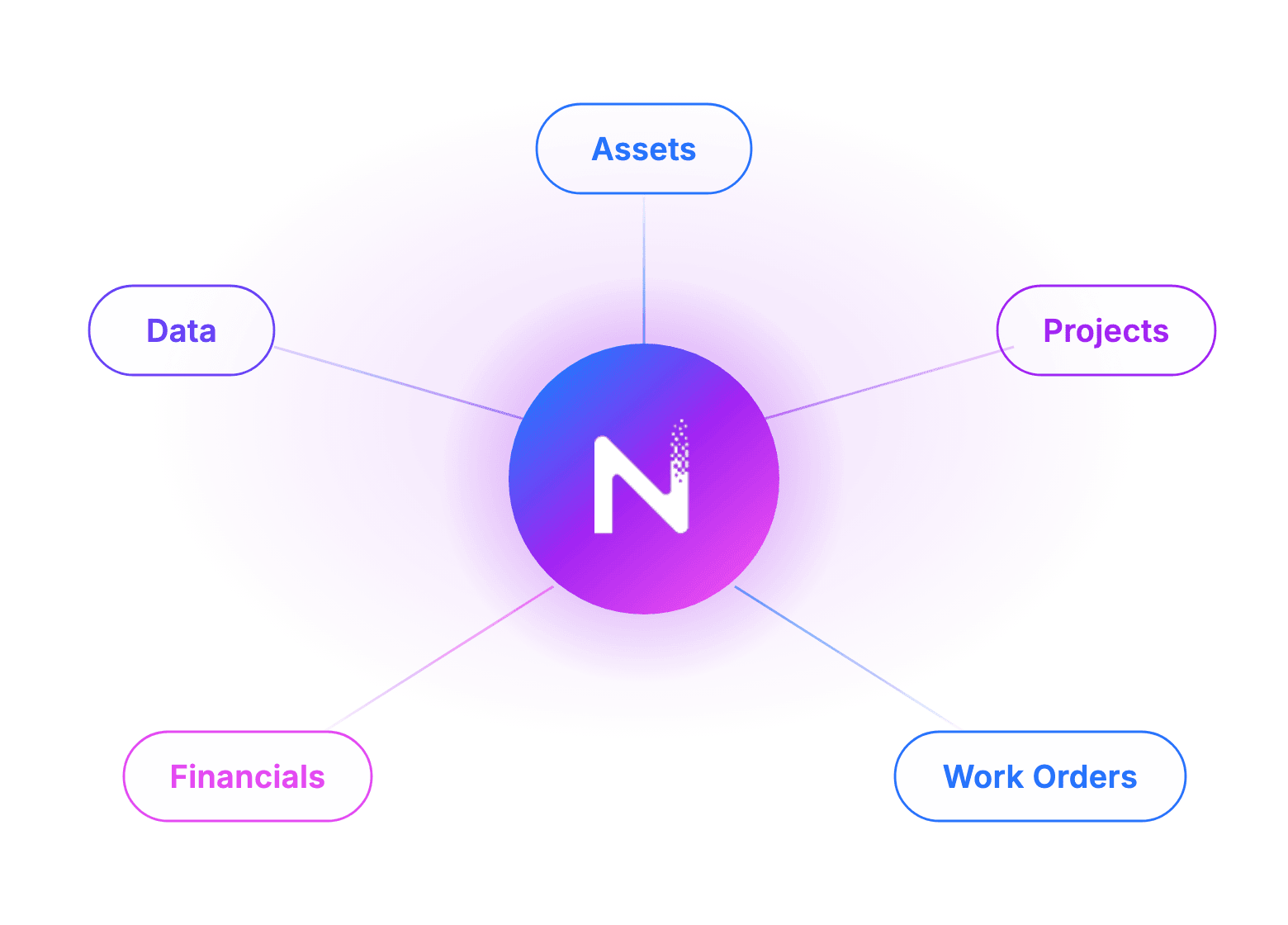
Data-driven planning
Investment decisions backed by real asset condition and cost data.
Aligned CIP and O&M
Capital and operational teams working from the same system.
Real-time visibility
Live financial impact across every phase, every decision.
Stronger communities
Better decisions, lower risk, more for every dollar spent.
We don’t implement systems. We design the system behind them.
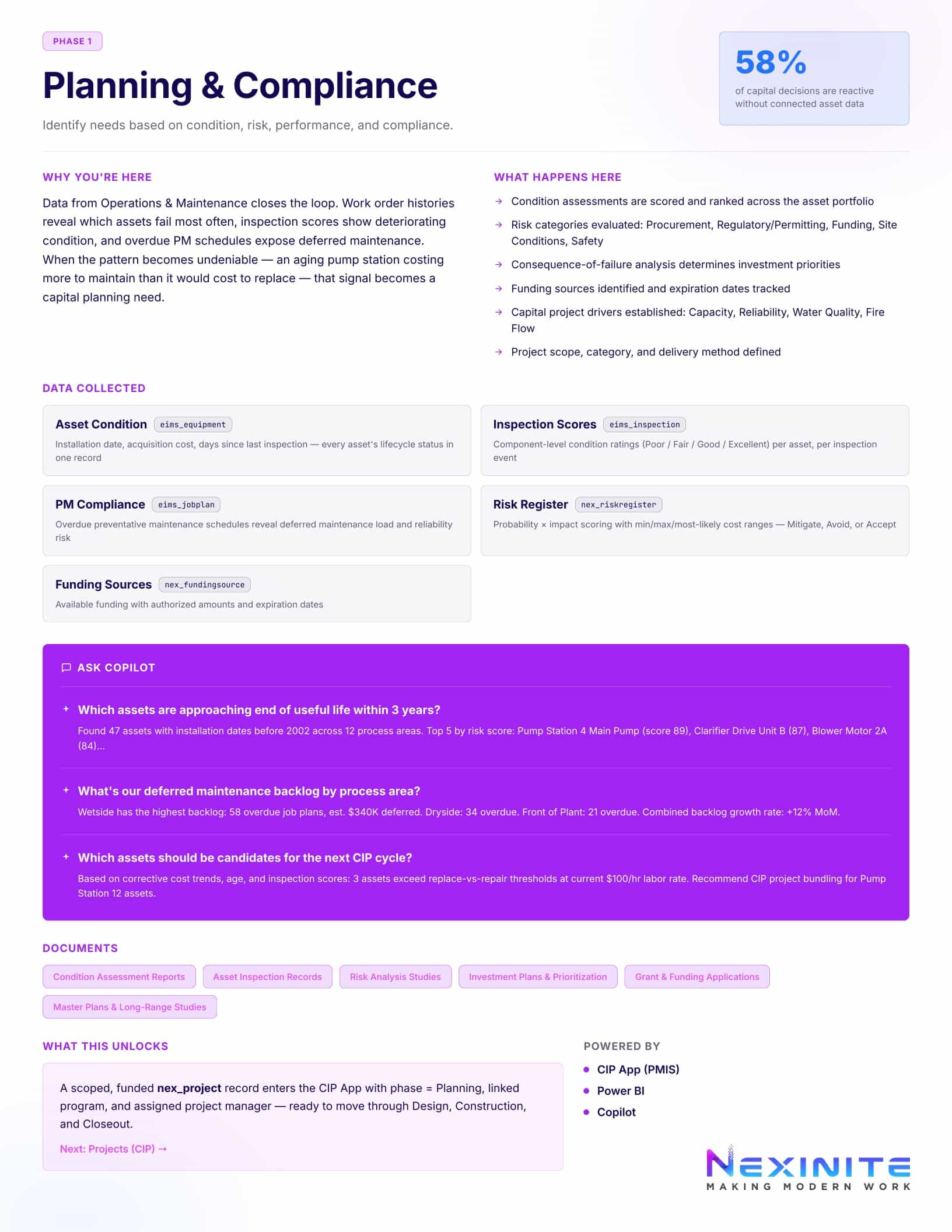
Phase 1
Turn needs into funded, scoped projects and manage from planning through closeout.
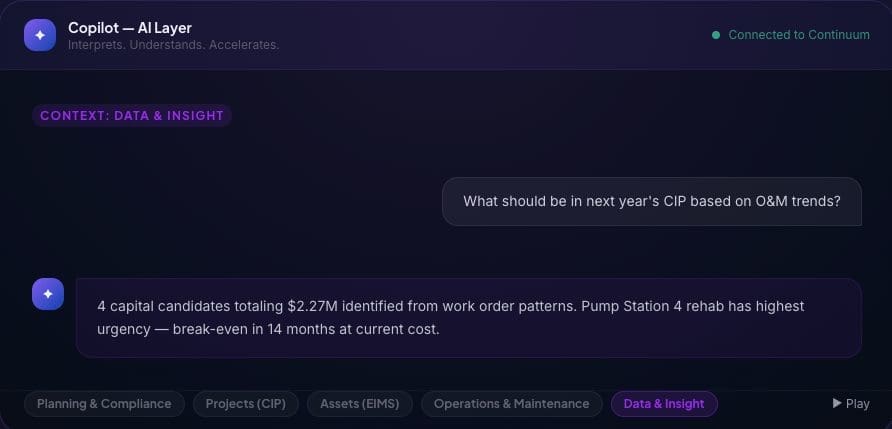
Data from Operations & Maintenance closes the loop. Work order histories reveal which assets fail most often, inspection scores show deteriorating condition, and overdue PM schedules expose deferred maintenance. When the pattern becomes undeniable — an aging pump station costing more to maintain than it would cost to replace — that signal becomes a capital planning need.
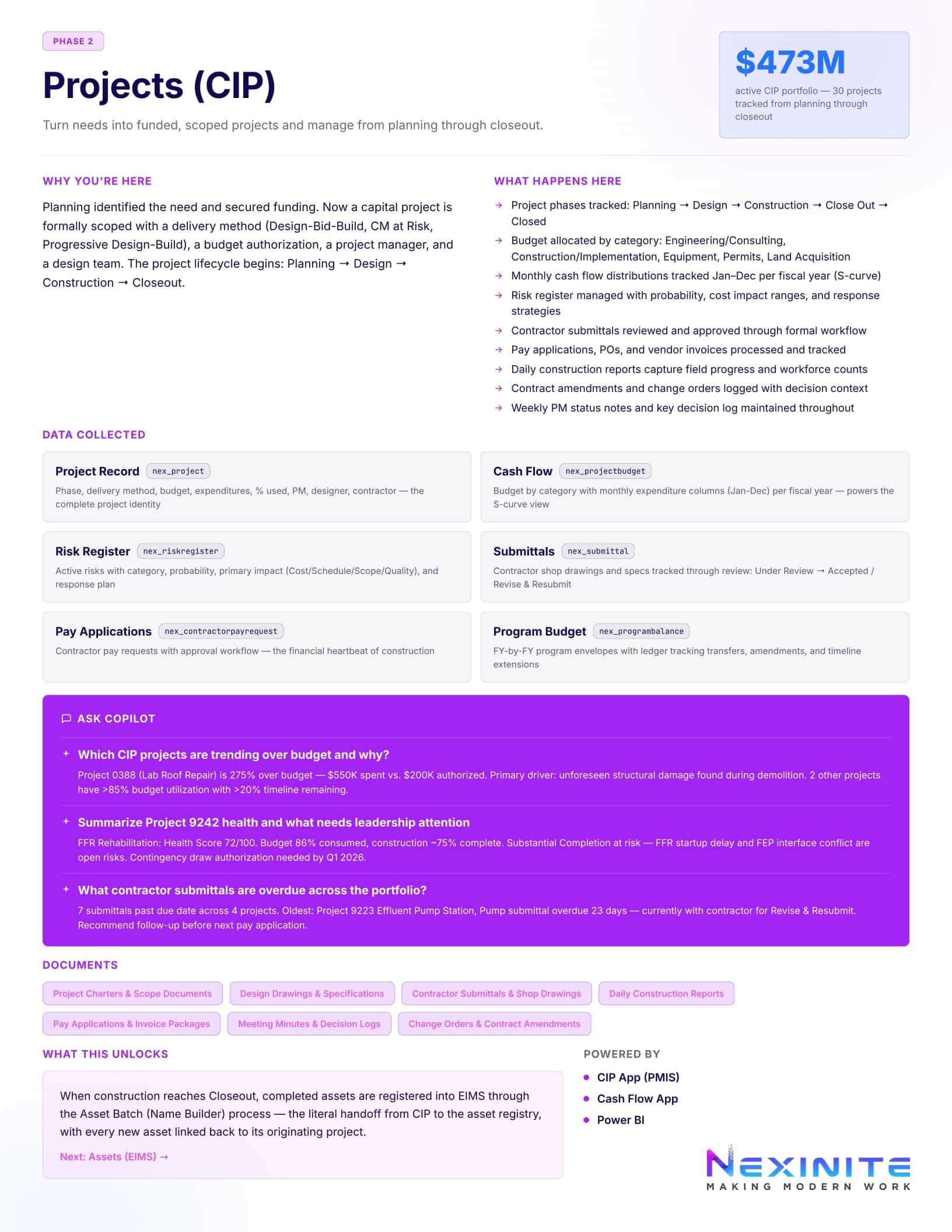
Phase 2
Turn needs into funded, scoped projects and manage from planning through closeout.
Planning identified the need and secured funding. Now a capital project is formally scoped with a delivery method (Design-Bid-Build, CM at Risk, Progressive Design-Build), a budget authorization, a project manager, and a design team. The project lifecycle begins: Planning → Design → Construction → Closeout.
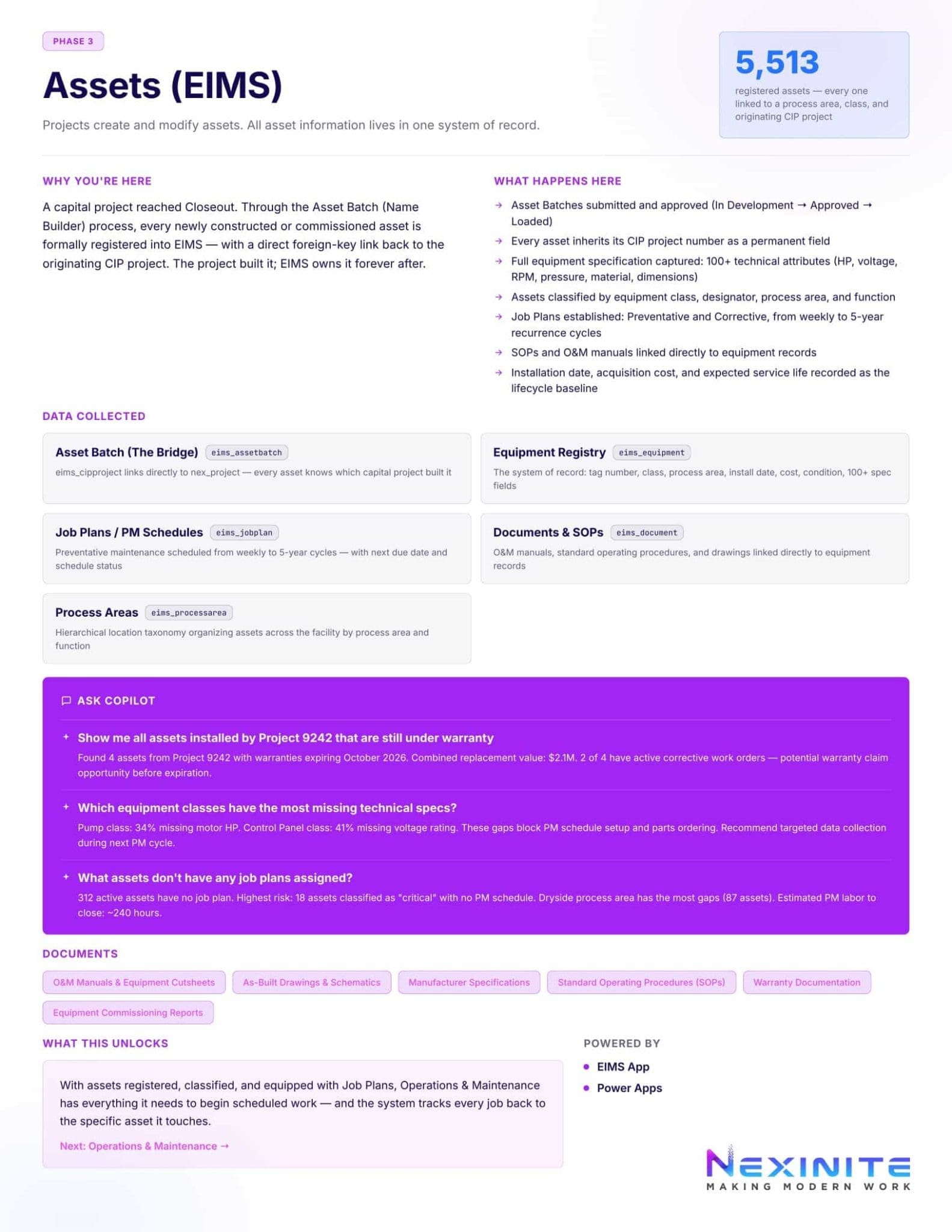
Phase 3
Projects create and modify assets. All asset information lives in one system of record.
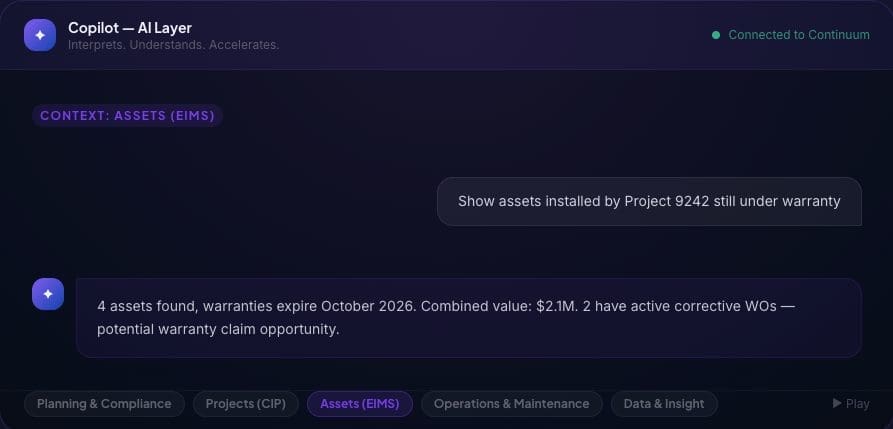
A capital project reached Closeout. Through the Asset Batch (Name Builder) process, every newly constructed or commissioned asset is formally registered into EIMS — with a direct foreign-key link back to the originating CIP project. The project built it; EIMS owns it forever after.
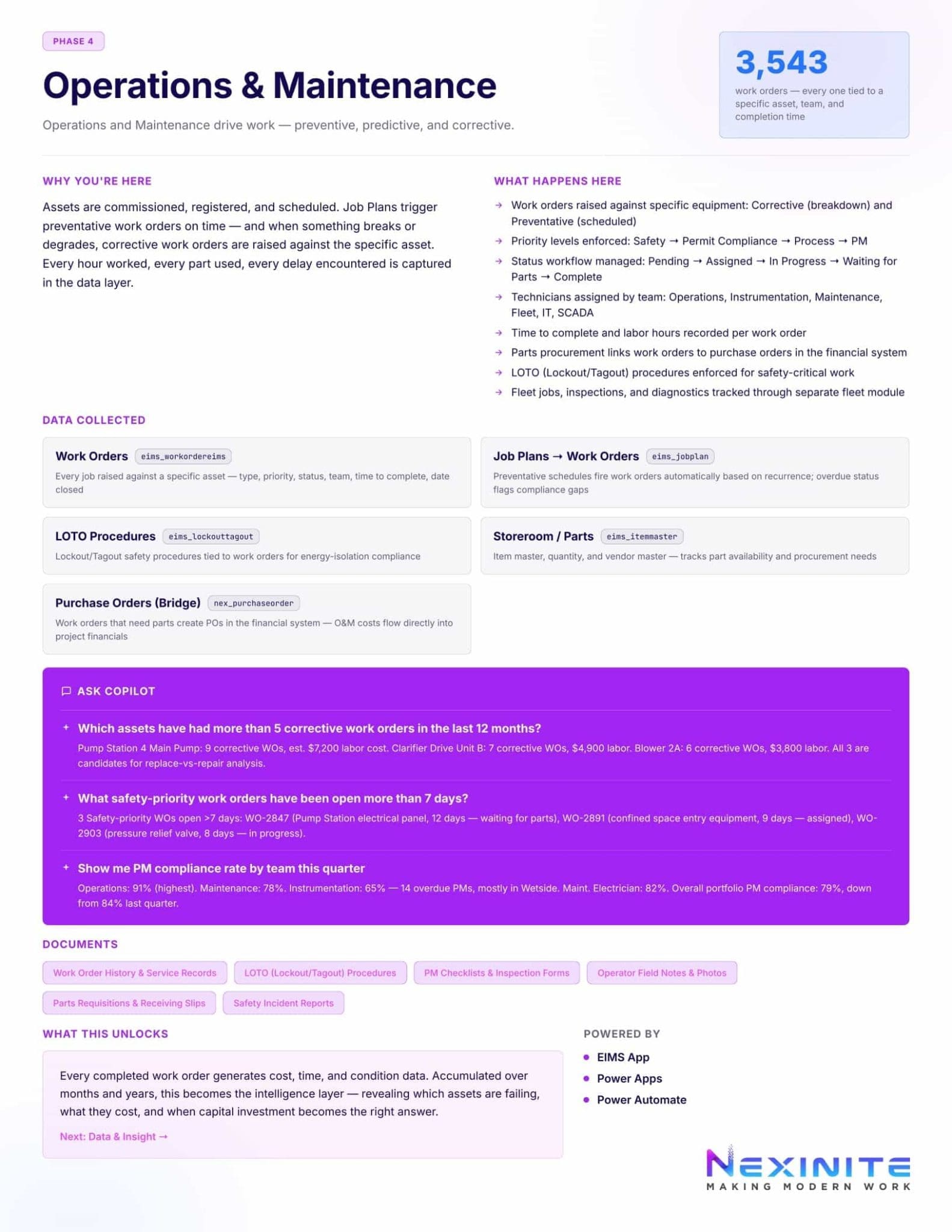
Phase 4
Operations and Maintenance drive work — preventive, predictive, and corrective.
Assets are commissioned, registered, and scheduled. Job Plans trigger preventative work orders on time — and when something breaks or degrades, corrective work orders are raised against the specific asset. Every hour worked, every part used, every delay encountered is captured in the data layer.
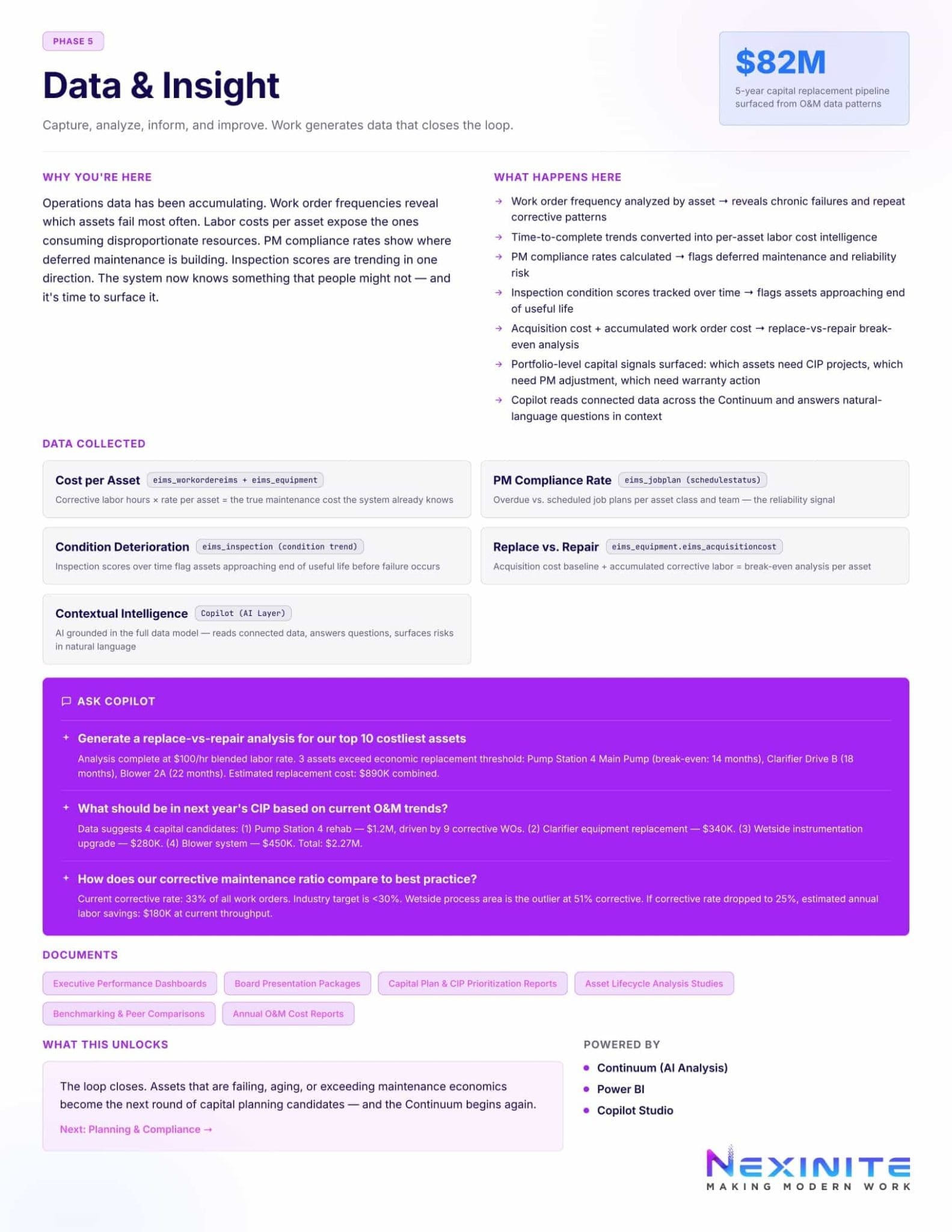
Phase 5
Capture, analyze, inform, and improve. Work generates data that closes the loop.
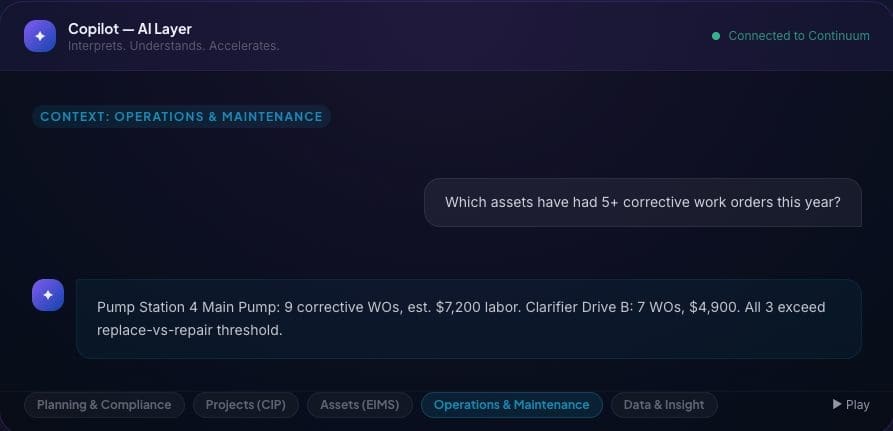
Operations data has been accumulating. Work order frequencies reveal which assets fail most often. Labor costs per asset expose the ones consuming disproportionate resources. PM compliance rates show where deferred maintenance is building. Inspection scores are trending in one direction. The system now knows something that people might not — and it’s time to surface it.
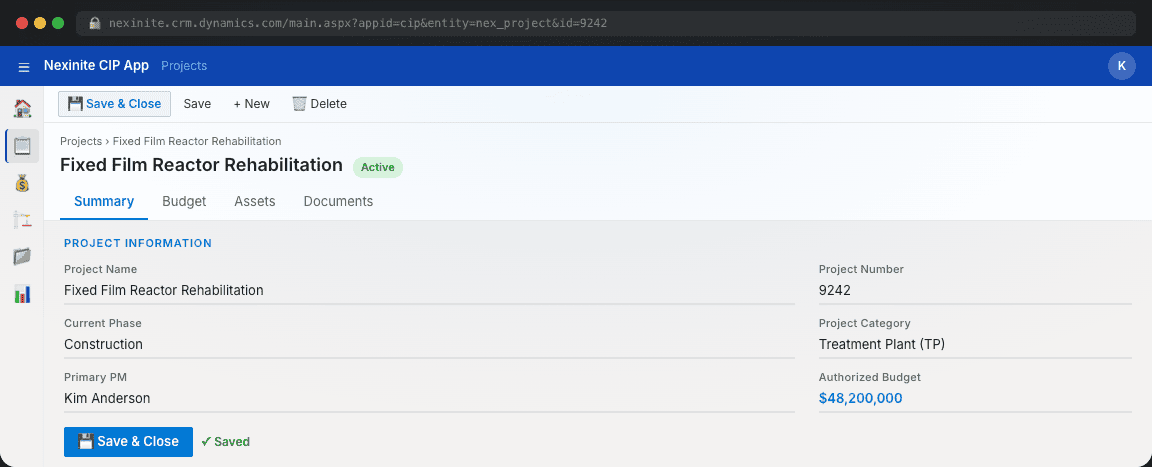
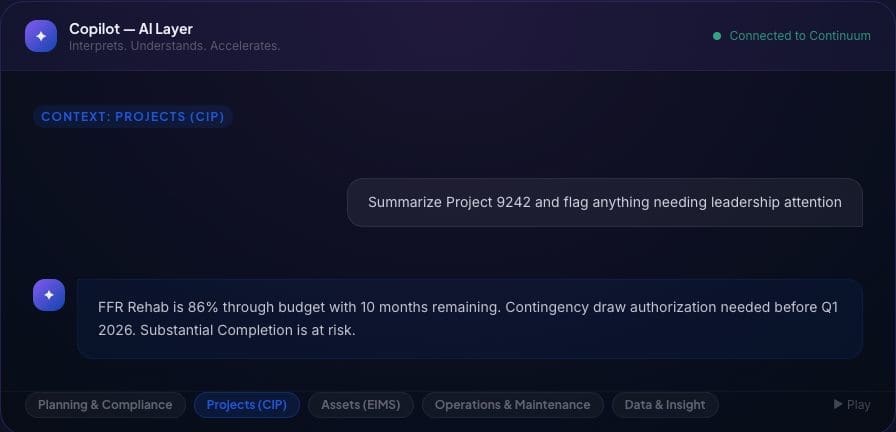
Create Project — Open the CIP App, fill in scope, phase, PM, and authorized budget — the project record is created in Dataverse.
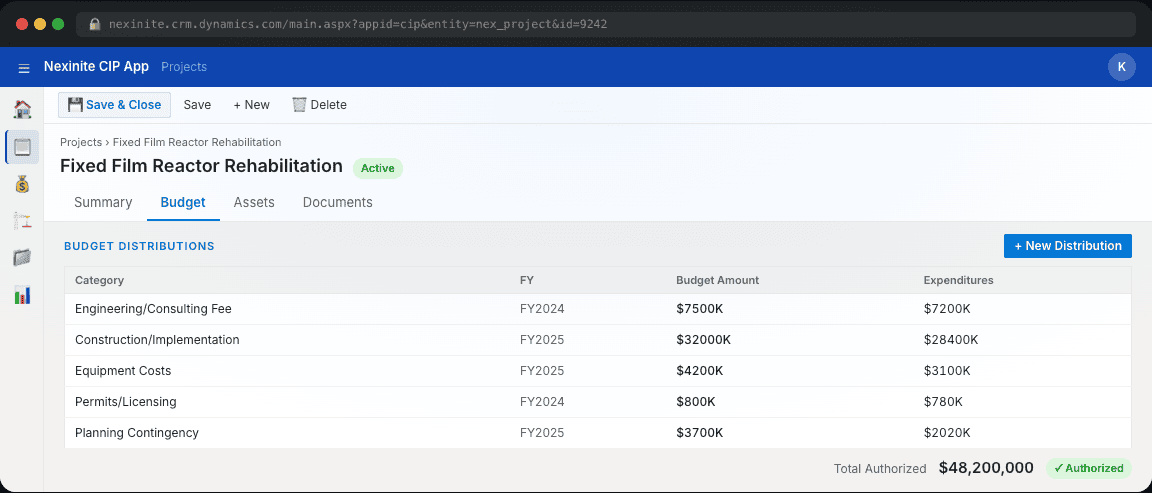
Set Up Budget — Add budget distributions by category and fiscal year, building the S-curve cash flow view automatically.
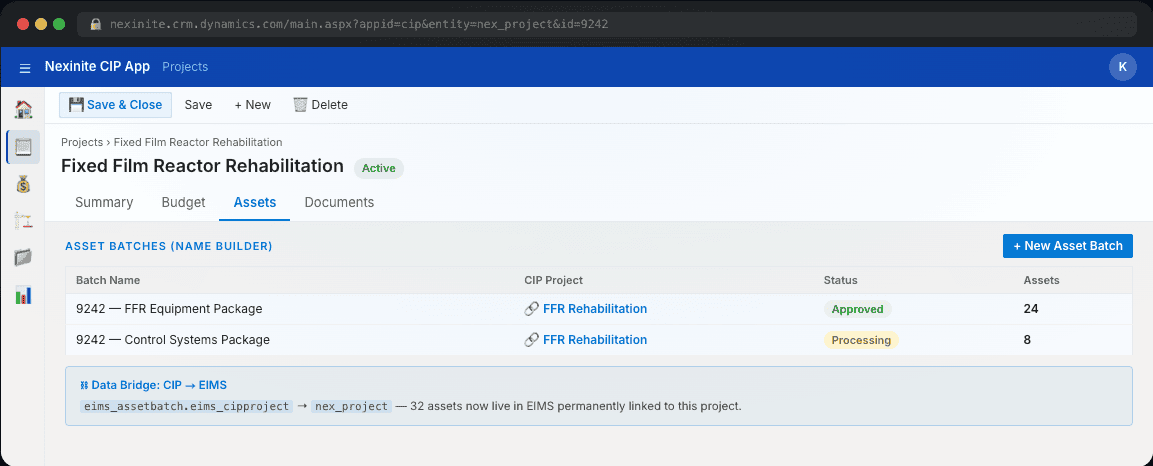
Link Asset Batch — Commission new assets through the Name Builder — each asset is permanently linked to this project via eims_assetbatch.
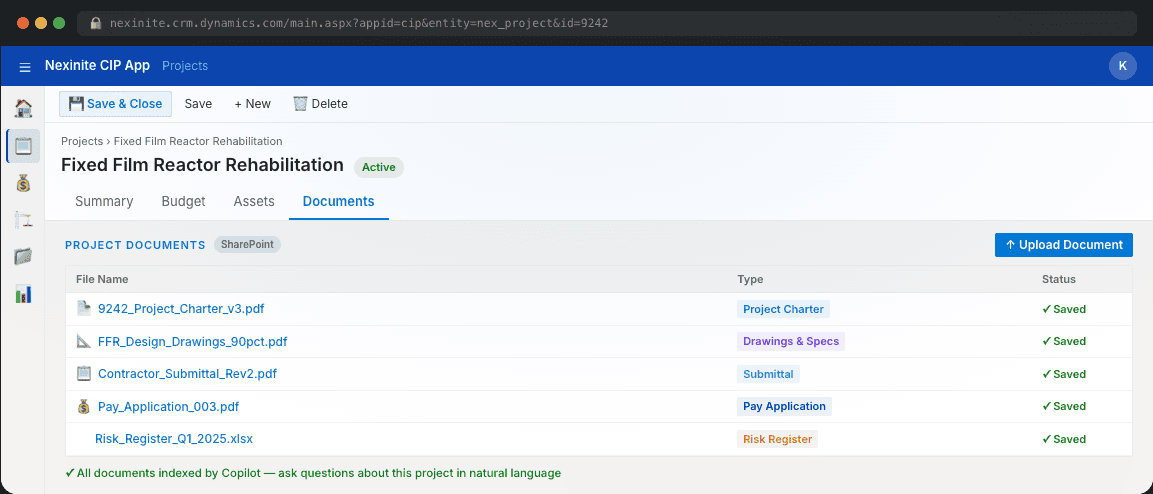
Attach Documents — Upload drawings, submittals, and pay applications to SharePoint — automatically indexed and searchable by Copilot.
Copilot interprets connected data, understands relationships, and delivers insight you can act on. When AI understands your context, it becomes useful. Until then, it’s just a demo.
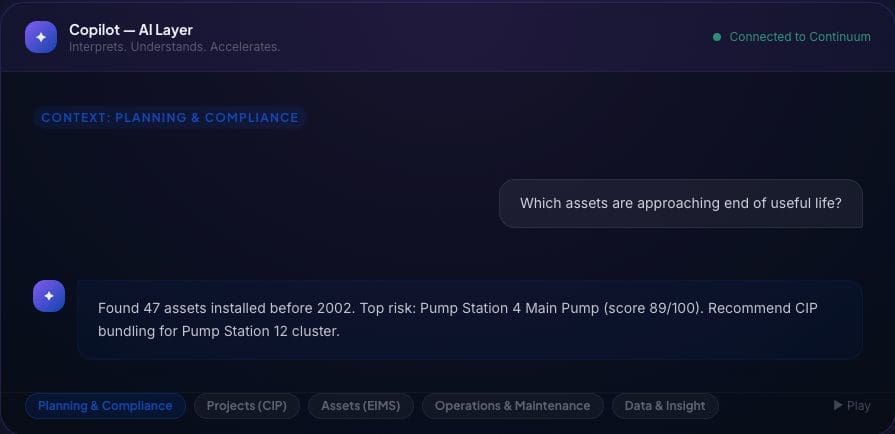

The Foundation
Budgets & Funding
Sets what’s possible and prioritizes needs
Commitments & Contracts
Locks in obligations and timing
Costs & Invoices
Tracks actuals and drives accountability
Forecasts & Constraints
All domains · SharePoint · Copilot Studio
We transform technology into a tool that works for you, enhancing your workflows and increasing productivity. Our expertise has helped numerous businesses navigate challenges and achieve their goals with reliable, effective solutions.
Sign up today for a monthly, laid-back email about changing how we work on programs & projects!
"*" indicates required fields
Absolutely. No two Continuum implementations are the same. Every deployment is designed around your organization’s business processes, governance model, information architecture, security requirements, operational workflows, and technology ecosystem.
Some organizations begin with document management or SharePoint modernization, while others focus on capital projects, asset management, AI, GIS, or operational reporting. The Continuum is intentionally designed as a flexible platform that adapts to your needs rather than forcing your organization into a predefined application.
The Continuum is intentionally designed as a configurable platform that evolves alongside your organization. Whether you’re adding new departments, facilities, business processes, data sources, or AI capabilities, the platform expands through configuration and integration rather than replacement.
Absolutely.
The Continuum is designed to integrate—not replace—your existing technology investments. Depending on your environment, it can connect with:
Our goal is to create one connected information environment rather than another isolated application.
No.
While many of our implementations have been for water, wastewater, utilities, and public infrastructure organizations, The Continuum is designed for any organization managing complex assets, facilities, projects, documents, and operational information.
AI is most valuable when it understands your organization’s context.
The Continuum prepares organizations for Microsoft Copilot and future AI capabilities by organizing documents, metadata, asset information, and business relationships into a trusted information foundation. This enables AI-powered search, document intelligence, summarization, recommendations, and decision support using your own enterprise knowledge.
Yes.
The Continuum is designed to serve as the information foundation for future digital twin initiatives by connecting documents, models, GIS data, asset records, inspections, operational information, and historical documentation.
Organizations can begin with document management today while preparing for future capabilities without redesigning the platform later.
The Continuum combines metadata, relationships, enterprise search, and AI-powered discovery to help users find information by asset, location, project, document type, facility, system, date, or business context—not simply by filename.
This dramatically reduces time spent searching for information while improving confidence that users are working from the correct version.
Absolutely.
Many organizations begin by solving a single business challenge—such as SharePoint modernization, document management, capital project management, governance, or Microsoft Copilot readiness.
Each Nexinite solution is designed as a building block within The Continuum, allowing organizations to expand over time without replacing previous investments. As new capabilities are added, they become part of one connected platform rather than another disconnected application.
Implementation timelines vary depending on scope, migration complexity, and integration requirements.
Many organizations begin with a focused pilot or phased implementation that delivers value within a few months, followed by incremental expansion as additional business processes and departments are incorporated.
Nexinite doesn’t sell off-the-shelf software or one-size-fits-all solutions. We design and configure Microsoft-based platforms that reflect how your organization actually operates.
Our team combines expertise in Microsoft 365, SharePoint, Power Platform, Dataverse, Power BI, governance, integrations, AI, and asset information management to deliver solutions that solve today’s operational challenges while establishing a scalable foundation for future growth.